The Anxiety Cycle How Stress Can Build Into Panic and How to Recognize Your Warning Signs
Anxiety does not always appear suddenly. For many people, stress and anxiety can gradually build over time, sometimes reaching a personal threshold where intense anxiety or a panic attack becomes more likely. This page explains how the anxiety cycle can develop, how your personal threshold can change, the warning signs that may appear before anxiety becomes overwhelming, and how recognizing these signs can help you interrupt the cycle and prevent it from taking over your life.
You may be able to continue working, taking care of your family, driving, shopping, and handling your normal responsibilities even while your stress and anxiety are gradually increasing. Because you are still functioning, it can be easy to overlook the signs that your overall anxiety load is becoming too high.
And you may not even realize how much has been building until anxiety suddenly becomes intense. And when that happens, the panic attack itself can become something you begin to fear, creating another layer of anxiety that can eventually lead to avoidance and keep the cycle going.
On This Page
- The Anxiety Cycle
- Anxiety May Begin Long Before Panic
- You Can Be Functioning While Anxiety Is Building
- Your Personal Anxiety Threshold
- Your Threshold May Not Be the Same Every Day
- What Pushes You Toward Your Threshold
- Recognize Your Early Warning Signs
- Pay Attention to What Your Mind Is Doing
- The "What If?" Chain
- Take the Thought Hostage
- When a Panic Attack Becomes Something You Fear
- When Avoidance Becomes Part of the Cycle
- The World Can Slowly Become Smaller
- Create Your Personal Warning System
- Make Your Warning Signs Personal
- Preventing the Cycle From Building Again
- Don't Wait for the Alarm to Become a Siren
- The Goal Is Not to Eliminate All Stress
- Turning the Cycle Around
- Recovery Is Not a Perfectly Straight Line
- Understanding the Cycle Is Part of Recovery
The Anxiety Cycle
Everyone experiences stress and anxiety differently, and not everyone who experiences anxiety or panic follows the same progression. But for some people, stress can gradually build into increasing anxiety, panic, fear of another attack, and eventually avoidance.
The pattern may look something like this:
Prolonged or accumulated stress
↓
Increasing anxiety and physical tension
↓
Panic attack or intense anxiety
↓
Fear of having another attack
↓
Increased attention to symptoms and "what if?" thinking
↓
Avoidance and safety behaviors
↓
Less confidence and a more restricted life
↓
More stress and anxiety
↓
The cycle repeats
Not everyone who experiences prolonged stress will develop panic attacks, and not everyone who experiences panic will develop agoraphobia. This is simply one way of understanding how anxiety can build, reinforce itself, and gradually affect the way a person thinks, feels, and responds.
The important part is that the cycle is not necessarily something you have to wait until the end of to address. There may be opportunities to recognize the buildup and interrupt the cycle along the way.
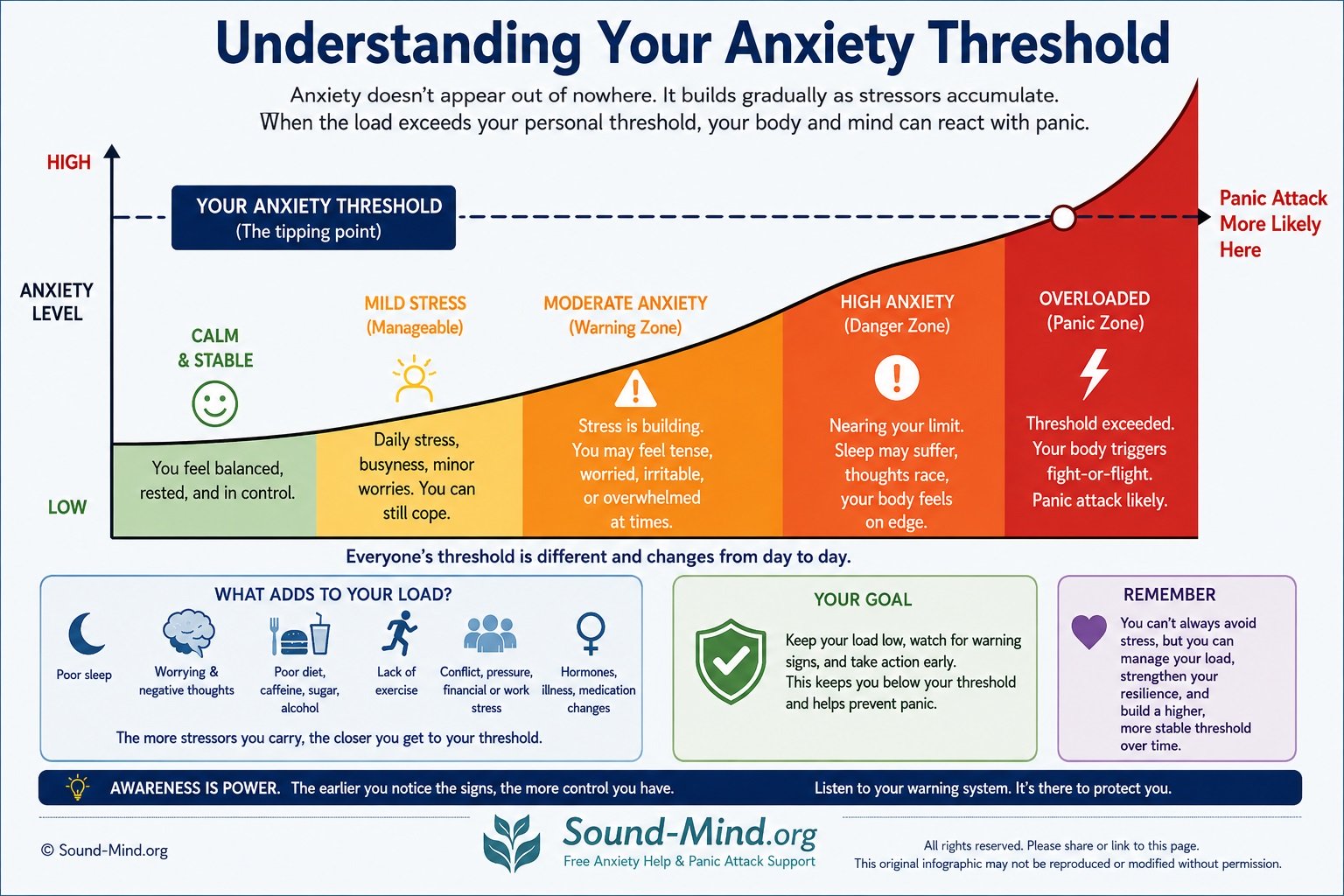
The threshold diagram above illustrates an important part of this process: your anxiety load is not necessarily fixed. What you can comfortably handle may change depending on your sleep, stress, physical health, thoughts, habits, and what else is happening in your life.
Anxiety May Begin Long Before the Panic Attack
One of the hardest things about recognizing anxiety is that the beginning of the process may not feel like anxiety at all. You may simply feel tired, have trouble sleeping, or find yourself dealing with more than usual at work or at home. Relationship problems, financial concerns, illness, grief, and other sources of stress can gradually add to your overall load.
You may also begin making changes that seem unrelated to anxiety. Perhaps you're drinking more caffeine because you're tired, exercising less because you're too busy, eating irregularly, or spending more time thinking about problems and less time relaxing. None of these things necessarily means that a panic attack is coming, but together they can contribute to your overall stress load.
And because you may still be working, taking care of your family, and handling your normal responsibilities, you may not realize that your anxiety is gradually building. You can be functioning while your stress and anxiety are still moving closer to your personal threshold.
You Can Be Functioning While Anxiety Is Building
This is something that is easy to overlook. A person can experience considerable anxiety and still continue going to work, taking care of children, cleaning the house, grocery shopping, driving, exercising, socializing, paying bills, and handling normal responsibilities.
You may have learned to push through discomfort. That ability to keep going is valuable. But there can be another side to constantly pushing through: you may begin overlooking the smaller signs that your stress and anxiety are accumulating. Several nights of poor sleep may not seem important. You may dismiss the fact that you have been worrying constantly, continue drinking caffeine even though it makes you feel more stimulated, or push aside the tension in your body. You may simply tell yourself that you'll deal with everything once things calm down.
And then a panic attack occurs.
"Why is this happening to me? I was handling things just fine."
One possibility is that you haven't been paying attention to the buildup of stressors that were quietly pushing you past your limit without you knowing.
Your Personal Anxiety Threshold
A useful way to understand the buildup is to think about your own anxiety threshold. Imagine that you have a certain capacity for handling stress, stimulation, physical strain, emotional pressure, and anxious thinking. When your overall load is relatively low, you may be able to handle a stressful situation without much difficulty.
As that load increases, however, you may become more vulnerable to anxiety. Eventually, you may reach a point where even a relatively minor additional stressor feels much more difficult to tolerate than it normally would. This can help explain why something that might not bother you on one day can feel overwhelming on another.
Your anxiety threshold is not a precise medical measurement or a number you can calculate. It is simply a way of thinking about your personal capacity for stress and anxiety—and that capacity can change from day to day.
Your Threshold May Not Be the Same Every Day
Consider something many people already understand about migraines. A person who experiences migraines may discover that several different factors can contribute to reaching their personal migraine threshold. Poor sleep, dehydration, certain foods, hormonal changes, stress, and other individual factors may combine to make a migraine more likely.
Anxiety can be thought about in a similar way. You may have several different things contributing to your overall anxiety load, and the combination of those factors can affect how much stress you are able to comfortably handle on a particular day.
Poor sleep + prolonged stress + too much caffeine + constant worrying + physical exhaustion
creates a very different internal environment than:
Good sleep + regular meals + exercise + manageable stress + calmer thinking.
Because your overall load can change, the same situation may feel completely different on two different days. You might drive somewhere without difficulty one week and feel unusually anxious about the same drive another week. You might walk into a crowded store without thinking twice one day and feel overwhelmed by it another day.
That does not necessarily mean the situation suddenly became dangerous. Your overall load may have changed. Understanding this can help you stop judging yourself by how you responded on one particular day and start paying attention to what else may have been building in the background.
Learn What Pushes You Toward Your Threshold
Your personal combination may be different from someone else's. What pushes one person closer to their anxiety threshold may have little effect on another. The important thing is to begin noticing the factors that tend to increase your own anxiety load.
Physical factors
- Poor sleep or physical exhaustion
- Skipping meals or eating irregularly
- Too much caffeine or other stimulants
- Lack of physical activity
- Illness, pain, or other physical discomfort
Emotional factors
- Prolonged stress or feeling overwhelmed
- Conflict or relationship difficulties
- Grief or major changes in your life
- Isolation or lack of support
Mental factors
- Excessive worrying or catastrophic thinking
- Constantly checking your body for signs of danger
- Repeatedly seeking reassurance
- Thinking about everything that could go wrong
- Repeated "what if?" questions
- Interpreting normal physical sensations as signs of danger
One factor by itself may not be enough to cause a noticeable increase in anxiety. But several factors occurring together can leave you feeling much more vulnerable and closer to your personal threshold.
This is why learning your own pattern can be so valuable. Instead of waiting until anxiety becomes overwhelming, you can begin recognizing the combination of factors that tells you, "My anxiety load is getting higher. I need to pay attention."
Recognize Your Early Warning Signs
Instead of waiting for a panic attack to tell you that your anxiety has become too high, begin paying attention to what happens before your anxiety becomes severe. Your warning signs may be different from someone else's, and they may not even look like obvious anxiety at first.
Perhaps you notice that you're not sleeping well, worrying constantly, checking your heart rate again, or having more "what if?" thoughts than usual. Maybe you've stopped doing the things that normally make you feel good, or you've noticed that your body has been tense for several days.
These may be your early warning signs.
Learning to recognize your own pattern gives you an opportunity to respond before your anxiety reaches a much higher level.
The goal is not to become constantly watchful for signs of anxiety. It is to become familiar enough with your own patterns that you can recognize when your overall stress load is beginning to rise so you can make adjustments before you reach your personal threshold.
Pay Attention to What Your Mind Is Doing
Your thoughts can also reveal that your anxiety load is increasing. You may notice yourself worrying more, imagining worst-case scenarios, replaying conversations, checking your body, searching for symptoms, seeking reassurance, or constantly thinking about future problems. You may also find yourself asking "what if?" over and over or becoming increasingly focused on whether you feel anxious.
These changes can be easy to dismiss, especially when they have become a habit. But they may tell you something important: your attention is becoming increasingly focused on danger.
The "What If?" Chain
An anxious thought does not always remain one thought. Once your mind begins looking for danger, one question can lead to another, creating a chain of increasingly frightening possibilities.
"My heart is beating fast."
↓
"Why is my heart beating fast?"
↓
"What if something is wrong?"
↓
"What if I'm having a panic attack?"
↓
"What if I can't control it?"
↓
"What if I faint?"
↓
"What if I can't get home?"
The original sensation may have been relatively minor, but the mind has added one frightening possibility after another. Each new "what if?" can create more fear, which can create more physical sensations, which can then give the mind even more material to worry about.
Learning to recognize this process can give you an opportunity to interrupt it before the chain continues to grow.
Take the Thought Hostage
You cannot prevent every anxious thought from entering your mind, and trying to eliminate every anxious thought can become another source of anxiety. Instead, learn to catch the thought before you automatically follow it.
Think of this as taking the thought hostage. Instead of immediately accepting the thought as fact or responding to it with another frightening possibility, pause and examine what your mind is telling you.
Ask yourself:
- What exactly am I thinking?
- Is this happening right now, or am I imagining something that might happen?
- Is this a fact, or is it a prediction?
- Have I started adding more "what ifs?" to the original thought?
- Am I interpreting a physical sensation as evidence of danger?
You don't have to argue with the thought, prove that it is wrong, or force yourself to think positively. The goal is simply to recognize when your mind has started feeding the anxiety and create a pause before automatically following the thought wherever it leads, which is typically to more anxious thoughts.
Sometimes that pause is enough to prevent one anxious thought from becoming an entire chain of frightening "what-if" possibilities.
When a Panic Attack Becomes Something You Fear
A panic attack can be an extremely frightening experience, and for some, completely traumatic. The sudden surge of fear and intense physical symptoms can make you believe that something catastrophic is happening, and even when the attack eventually passes, the experience can stay with you for a long time. After experiencing something that frightening, it is understandable to think, "What if it happens again?" That thought does not necessarily mean you are developing a serious problem; you may simply be remembering an experience that scared you and hoping not to experience it again.
The important distinction is what happens next. If you understand that anxiety can build, recognize your own warning signs, and respond proactively by managing your stress and allowing your nervous system time to settle, you may be able to regain your balance without becoming trapped in a fear-of-panic cycle.
But sometimes the fear of another panic attack begins to create anxiety of its own. You may start monitoring your body closely, paying attention to your heartbeat, breathing, dizziness, or other sensations and wondering whether each one means another attack is beginning. You may begin thinking about where you are, whether you could leave quickly, or whether someone would be able to help you if you became panicked.
At this point, the fear of panic itself can become part of the anxiety cycle. Instead of simply responding to anxiety when it appears, you may begin organizing your life around trying to prevent anxiety or panic from happening.
There is an important difference between being cautious after a frightening experience and becoming afraid of the experience itself.
When fear of panic begins to control your thoughts, decisions, or activities, it can become much more difficult to break the cycle.
This is one reason it is so valuable to recognize the cycle early. The sooner you learn to respond to rising stress and anxiety, the less opportunity there may be for fear of panic to become another source of anxiety.
If fear of panic has already become deeply established, however, simply understanding the cycle may not be enough. You may need to give the problem more focused attention through dedicated practice, structured recovery exercises, or help from a qualified mental health professional. There is no failure in needing additional support; sometimes a pattern that has been reinforced for a long time requires more deliberate work to change.
The goal is not to guarantee that you will never experience anxiety or another panic attack. It is to become less afraid of anxiety itself, more confident in your ability to handle uncomfortable sensations and thoughts, and better able to recognize when your stress load is rising before the cycle becomes overwhelming.
When Avoidance Becomes Part of the Cycle
Suppose you become anxious in a particular place and decide to leave. Your anxiety eventually decreases, which can feel like proof that leaving was the right decision: "I knew I needed to get out." The relief is real, but your mind may also learn that leaving was what kept you safe.
The next time you enter that situation again, you may become more anxious and even sooner than before. You may begin looking for an exit, deciding that you need someone with you, or avoiding the situation altogether. Avoidance can provide immediate relief, but over time it can also prevent you from discovering that you may be capable of tolerating anxiety and remaining in the situation. In many cases, leaving can only bring more intense fear for next time.
This is one reason avoidance can become self-reinforcing. For some people, increasingly avoiding places or situations because escape or help might feel difficult can contribute to agoraphobic patterns.
The World Can Slowly Become Smaller
This progression can happen so gradually that you may not recognize how much your life is changing. What begins as a small adjustment can eventually become a series of rules about where you can go, how far you can travel, and who needs to be with you.
"I don't like driving on the highway."
↓
"I'll take the back roads."
↓
"I'll only drive if someone is with me."
↓
"Maybe I'll just stay home."
At each stage, the decision may seem reasonable because it reduces anxiety in the moment. The concern is when fear increasingly determines what you are allowed to do.
The more your world becomes organized around preventing anxiety, the more important it becomes to examine whether avoidance itself is keeping the fear alive.
Create Your Personal Warning System
Rather than waiting for another panic attack to tell you that your anxiety has become too high, begin learning what happens before you reach that point. Think back to previous periods when your anxiety became severe and look for what was happening in the days or hours leading up to it.
Ask yourself:
- How had I been sleeping?
- Was my stress level higher than usual?
- Was I eating regularly or drinking more caffeine?
- Was I exercising or physically exhausted?
- Was I feeling emotionally overwhelmed?
- What was I thinking about?
- Was I worrying more or having more "what if?" thoughts?
- Was I checking my body or seeking reassurance?
- Was I becoming increasingly tense or irritable?
- Was I beginning to avoid anything?
Your answers may reveal a pattern. Once you recognize that pattern, you have something valuable: an early warning system that is specific to you.
Make Your Warning Signs Personal
You don't need to figure everything out at once. Start with the signs you have already noticed and create a short list that you can recognize when your anxiety load begins to rise.
My Early Warning Signs
- I stop sleeping well.
- I begin worrying more.
- I drink more caffeine because I'm tired.
- I become physically tense.
- I start checking my body.
- I have more catastrophic thoughts.
- I ask more "what if?" questions.
- I stop exercising.
- I become more irritable.
- I start avoiding things.
- I feel like I need more reassurance.
Your list may look completely different. You might have only three warning signs, or you might discover ten. The important thing is that the list belongs to you.
Preventing the Cycle From Building Again
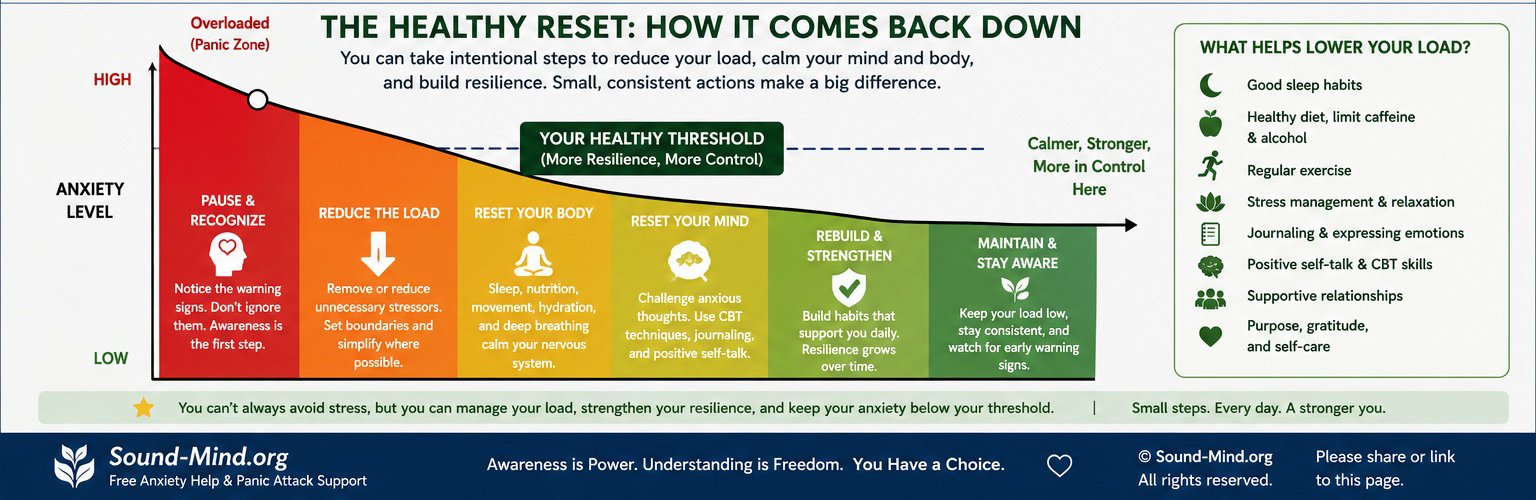
Once you begin recognizing your personal warning signs, you can use them as an opportunity to intervene earlier. Prevention is not about eliminating anxiety from your life or guaranteeing that you will never experience another panic attack. It is about understanding what tends to increase your anxiety and responding before the buildup becomes overwhelming.
If poor sleep repeatedly leaves you more vulnerable to anxiety, make sleep a priority. If excessive caffeine seems to increase your physical symptoms, pay attention to how much you are consuming. If inactivity leaves you feeling more tense and stressed, return to regular movement. If prolonged stress is pushing you toward your threshold, look for ways to reduce or manage that stress rather than continuing to ignore it.
Pay attention to your thoughts as well. If you notice your mind becoming filled with catastrophic "what if?" thoughts, catch them before they multiply. If you notice yourself beginning to avoid situations because you are afraid of becoming anxious, recognize that pattern early rather than allowing avoidance to gradually take over more of your life.
These are not separate pieces of recovery. They are ways of maintaining the progress you are making and keeping your overall anxiety load at a more manageable level.
This is also where the skills taught throughout the Sound-Mind Recovery Steps can become part of your long-term prevention strategy. The goal is not to live your life constantly trying to prevent anxiety. It is to become familiar with your own warning signs and have healthy ways to respond when you notice your stress beginning to rise.
Don't Wait for the Alarm to Become a Siren
Think about a smoke alarm. You don't want to wait until the entire house is filled with smoke before paying attention. The earlier warning gives you more time to understand what is happening and respond before the situation becomes more difficult to manage.
Anxiety can be similar. A mild increase in tension may be easier to address than a full panic attack. A few nights of poor sleep may be easier to correct than weeks of exhaustion. A single anxious thought may be easier to examine than an entire afternoon spent catastrophizing. The earlier you recognize what is building, the more opportunities you may have to respond.
Recognizing the buildup does not mean becoming afraid of every anxious feeling. It means learning to listen earlier.
Use Your Recovery Skills Before Anxiety Escalates
The habits and skills you develop during recovery can also help you recognize and manage the buildup of stress and anxiety.
The Goal Is Not to Eliminate All Stress
You cannot create a life without stress. You cannot prevent every anxious thought or guarantee that you will never experience another uncomfortable physical sensation. And you don't need to.
The goal is not to live your life thinking: "I must never feel anxious."
Instead, the goal is: "I want to recognize anxiety earlier and respond to it differently."
That is a much more realistic goal. You are learning to recognize your own patterns rather than being surprised by them, and to respond before anxiety has the opportunity to build into something much more overwhelming.
Turning the Cycle Around
The cycle can be described in two very different ways.
The cycle that feeds anxiety:
Stress → Anxiety → Fear of symptoms → Panic → Fear of panic → Avoidance → Temporary relief → Less confidence → More restriction → More stress → More anxiety
The cycle that builds recovery:
Notice → Understand → Examine the thought → Respond instead of automatically reacting → Address accumulated stress → Continue participating in life → Build confidence → Reduce fear
This second cycle does not mean that you will never feel anxious again. It means that anxiety no longer has to determine everything you do.
Recovery Is Not a Perfectly Straight Line
Understanding your anxiety cycle does not mean you will never experience anxiety again.
There may still be stressful periods, difficult days, setbacks, or times when your anxiety rises unexpectedly. You may even experience another panic attack.
That does not mean you have lost everything you have learned or returned to where you started.
Recovery is not always a perfectly straight line. There may be times when your threshold feels lower than usual, especially during periods of increased stress, poor sleep, or other challenges.
Instead of asking:
"Why am I back at square one?"
Try asking:
"What can I learn from what happened?"
What was building?
What did you miss?
What was your mind telling you?
How did you respond?
What might you recognize earlier next time?
These questions are not about blaming yourself. They are about becoming more familiar with your own patterns and learning what helps you when anxiety begins to build.
A Setback Does Not Erase Your Progress
Having a difficult day, experiencing a surge of anxiety, or even having another panic attack does not erase what you have learned.
Recovery is about learning how to respond differently over time. Each time you understand what happened, recognize your patterns, and begin again, you are building greater awareness and confidence in your ability to handle anxiety.
Understanding the Cycle Is Part of Recovery
The purpose of understanding the anxiety cycle isn't to make you monitor yourself constantly or become afraid that every stressful day will lead to panic.
It is the opposite.
The more you understand your own patterns, the less mysterious they can become.
You can begin recognizing that anxiety can have a buildup.
You can learn that your threshold can change.
You can become aware of the thoughts that add fuel to your anxiety.
You can recognize when fear of panic is beginning to influence your decisions.
You can notice when avoidance is creeping into your life.
And you can begin responding earlier.
Your goal isn't to create a life where nothing ever makes you anxious.
Your goal is to build enough understanding and confidence that anxiety no longer has to run your life.
If you are experiencing recurrent panic attacks, significant avoidance, or anxiety that is interfering with daily life, consider talking with a healthcare or mental-health professional. Panic and anxiety conditions are treatable, and evidence-based treatments can help people change patterns of fear and avoidance.
🌿 Share the Hope
If this article encouraged you, please consider sharing it with a friend, family member, or anyone who may be struggling today. Sometimes a single article can be the reminder someone needs that they are not alone.
Guided Steps to Recovery
Natural Supplements
Stress and anxiety can sometimes lead people to search for quick ways to feel better. Natural options such as herbs, vitamins, and supplements are one choice some people explore as part of a healthier approach to managing symptoms. Developing positive coping strategies can help reduce the temptation to rely on unhealthy habits, including alcohol or other substances.